Sugarcane Irrigation System: Water Management Practices for Higher Yield and Recovery
Irrigation for sugarcane plays a decisive role in determining cane yield, sugar recovery, and overall farm profitability. Sugarcane is a long-duration crop with high water requirements, and it remains in the field for 10 to 14 months depending on the region and variety. In India, where sugarcane is cultivated in states such as Uttar Pradesh, Maharashtra, Karnataka, Tamil Nadu, Bihar, and Gujarat, proper irrigation management is essential for sustaining productivity.
Unlike short-duration crops, sugarcane demands consistent moisture throughout most of its growth cycle. Water stress at critical stages can significantly reduce cane girth, internode length, and overall biomass. On the other hand, excessive irrigation can cause waterlogging, nutrient loss, and reduced sugar content. Therefore, balanced and timely irrigation for sugarcane is key to achieving both high yield and good quality.
Importance of Irrigation in Sugarcane Cultivation
Sugarcane has a deep and extensive root system, but its high biomass production requires a large and continuous water supply. Proper irrigation ensures uniform germination, vigorous tillering, and healthy cane elongation.
In irrigated areas, sugarcane yields are substantially higher than in rainfed regions. Assured irrigation allows farmers to apply fertilizers efficiently, manage ratoon crops effectively, and maintain steady growth even during dry spells. Since sugarcane contributes significantly to the rural economy and sugar industry, irrigation management directly affects both farmers and mills.
Water Requirement of Sugarcane
Sugarcane is considered one of the most water-intensive field crops. The total water requirement ranges between 1500 mm and 2500 mm over the crop duration, depending on climate, soil type, and crop variety.
Factors influencing water requirement include:
- Duration of the crop (early, mid-late, or late varieties)
- Temperature and evaporation rate
- Soil texture and water-holding capacity
- Method of irrigation used
In tropical regions with high temperatures, evapotranspiration rates are higher, increasing water demand. Sandy soils require more frequent irrigation than clay soils due to lower moisture retention.
Critical Growth Stages for Irrigation in Sugarcane
Irrigation for sugarcane must be carefully planned according to its growth phases. Certain stages are highly sensitive to moisture stress and directly influence yield.
Germination Stage (0–45 Days)
During germination, adequate soil moisture is essential for sprouting of setts and root establishment. Insufficient moisture at this stage leads to poor germination and uneven crop stand.
Light and frequent irrigation is recommended, especially in summer planting.
Tillering Stage (45–120 Days)
At the tillering stage, the plant produces multiple shoots from the base. Proper irrigation during this period ensures maximum tiller formation and reduces mortality of weak shoots.
Water stress during tillering can permanently reduce cane population per unit area.
Grand Growth Phase (120–270 Days)
This is the most critical phase in sugarcane cultivation. Rapid elongation of stalks takes place, and the crop accumulates maximum biomass. The demand for water is highest during this period.
Moisture stress in the grand growth phase significantly reduces cane height, girth, and weight. Regular irrigation at appropriate intervals is necessary.
Maturity Phase (270 Days to Harvest)
During maturity, excessive irrigation should be avoided as it may reduce sugar accumulation. Irrigation intervals are widened, and in some cases, irrigation is stopped 2–3 weeks before harvest to improve sucrose content.
Frequency and Scheduling of Irrigation
The frequency of irrigation for sugarcane depends on soil type and climate conditions.
- In sandy soils: irrigation every 7–10 days during summer
- In loamy soils: irrigation every 10–15 days
- In clay soils: irrigation every 15–20 days
During winter months, irrigation intervals can be extended due to lower evaporation rates. Proper scheduling based on soil moisture observation is more effective than following fixed calendars.
Best Irrigation Systems for Sugarcane
Furrow Irrigation
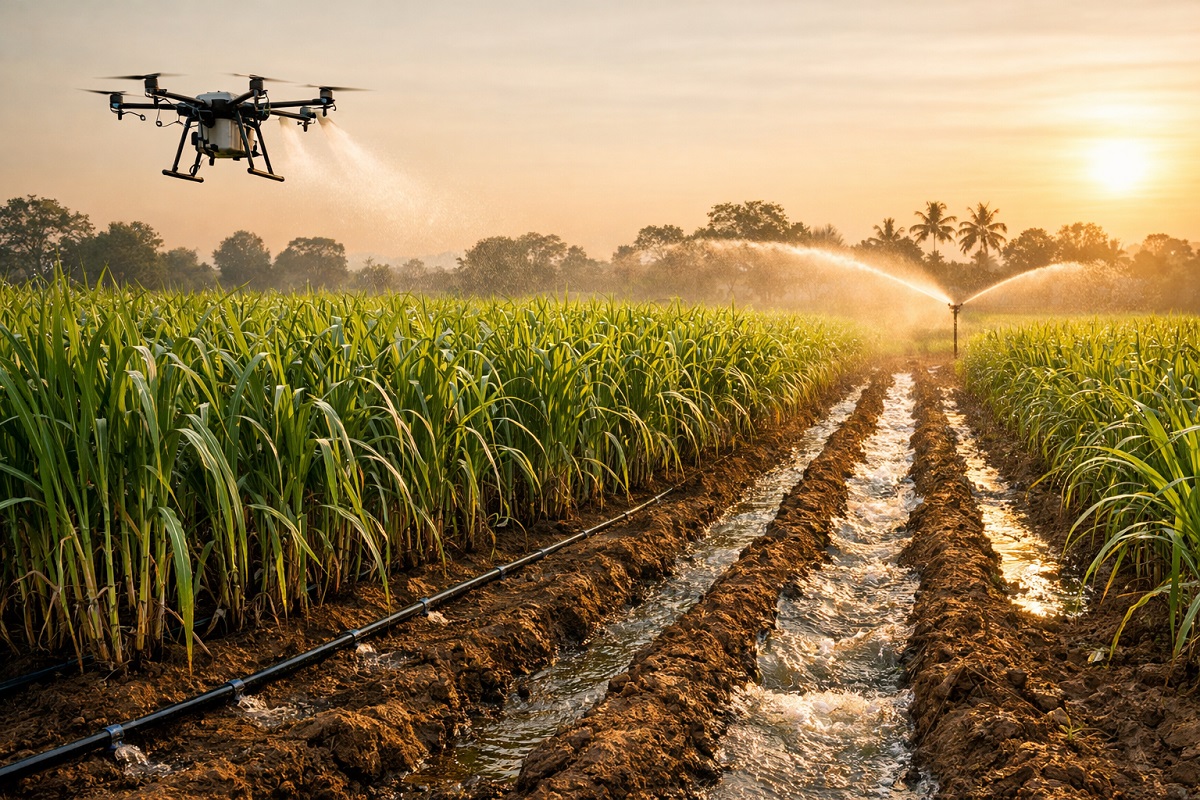
Furrow irrigation is the most common method used in sugarcane fields. Water flows through furrows between crop rows and infiltrates into the root zone.
This method is simple and cost-effective but may lead to uneven distribution if land leveling is poor. Deep percolation losses are common in sandy soils.
Alternate Furrow Irrigation
In this method, water is applied to alternate furrows instead of every furrow. This reduces water use while maintaining adequate soil moisture.
Alternate furrow irrigation improves water-use efficiency without significant yield reduction.
Drip Irrigation
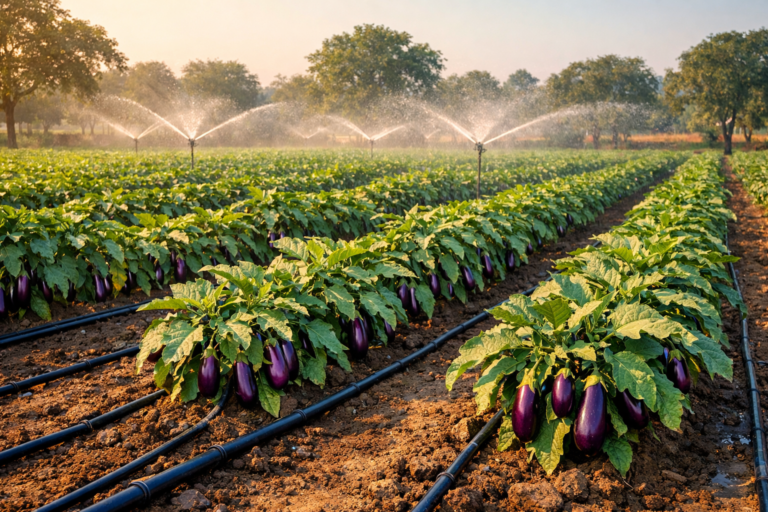
Drip irrigation is increasingly promoted for sugarcane cultivation, especially in water-scarce regions. Water is delivered directly to the root zone through emitters placed along lateral lines.
Advantages of drip irrigation include:
- Water savings of 30–50%
- Higher yield compared to conventional methods
- Reduced weed growth
- Improved fertilizer efficiency through fertigation
Although initial installation costs are higher, long-term benefits make drip irrigation suitable for commercial sugarcane farming.
Sprinkler Irrigation
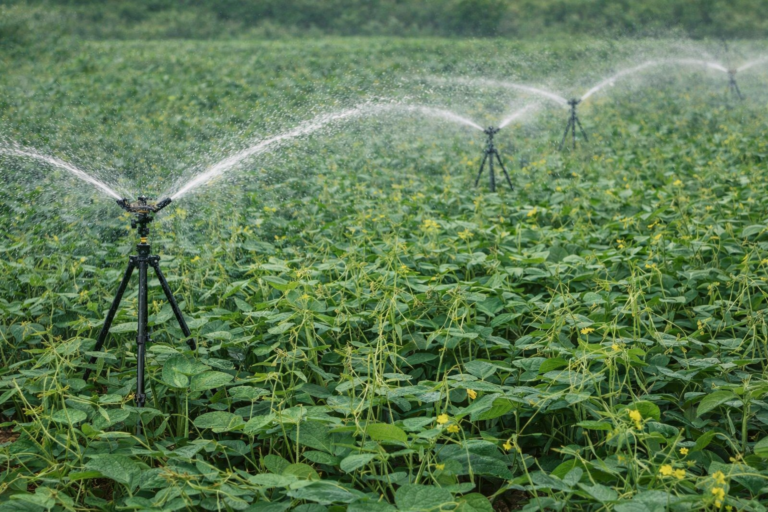
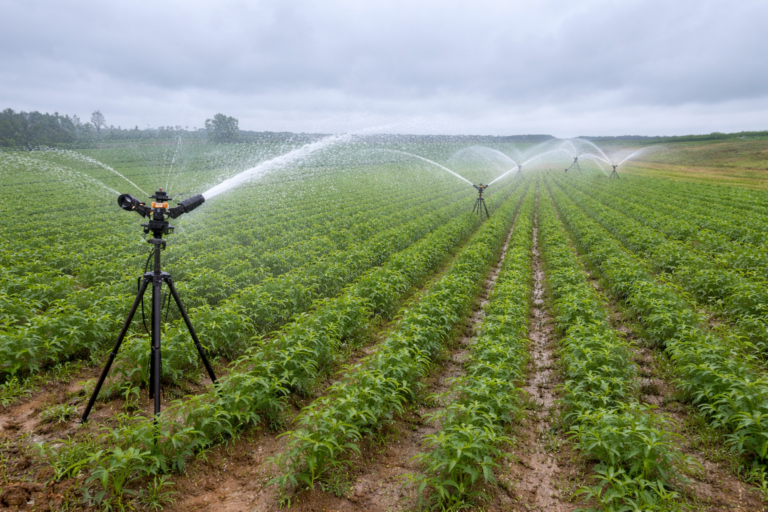
Sprinkler irrigation can be used in uneven terrain and light soils. However, due to the tall crop canopy in later stages, sprinkler use becomes less practical compared to drip systems.
Drone-Based Irrigation and Smart Water Management
Drone irrigation is an emerging technology in modern sugarcane farming, particularly in large commercial fields and water-scarce regions. While drones are not typically used to directly irrigate large-scale sugarcane fields with bulk water (due to the crop’s high water requirement), they play a significant role in precision water management.
Agricultural drones equipped with multispectral and thermal sensors help monitor crop health, soil moisture status, and water stress levels across the field. By identifying dry patches and uneven moisture distribution, farmers can make informed irrigation decisions and avoid both under- and over-irrigation.
Key applications of drone technology in sugarcane irrigation include:
- Mapping soil moisture variability across large fields
- Detecting early signs of water stress in the grand growth phase
- Identifying waterlogging or drainage issues
- Supporting precision irrigation scheduling
- Targeted spraying of water-soluble fertilizers through aerial application in specific zones
Benefits of drone-assisted irrigation management:
- Improved water-use efficiency
- Reduced irrigation costs
- Better fertilizer utilization when integrated with fertigation systems
- Early detection of stress leading to timely corrective action
When combined with drip irrigation systems and soil moisture sensors, drone monitoring creates a smart irrigation ecosystem that enhances productivity while conserving water. Though initial investment may be high, drone-based monitoring is becoming increasingly viable for progressive sugarcane farmers and agribusinesses.
Water Management in Ratoon Sugarcane
Ratoon crops, grown from the stubble of harvested cane, require careful irrigation management. Immediate irrigation after harvest encourages sprouting of ratoon shoots.
Since the ratoon crop has an established root system, early irrigation ensures uniform regrowth and higher ratoon yield.
Drainage and Waterlogging Issues
While sugarcane requires high water input, it is sensitive to prolonged waterlogging. Poor drainage leads to root rot, nutrient deficiency, and reduced tillering.
Providing proper field drains and avoiding over-irrigation are essential to prevent stagnation.
Impact of Irrigation on Fertilizer Efficiency
Efficient irrigation improves nutrient uptake and enhances crop growth. In drip systems, fertigation allows precise application of fertilizers directly to the root zone.
Over-irrigation, however, can cause leaching of nitrogen and potassium, increasing production costs and reducing efficiency.
Water-Saving Strategies in Sugarcane Farming
Given the high water demand of sugarcane, adopting water-saving techniques is critical for sustainability.
- Adoption of drip irrigation systems
- Mulching to reduce evaporation losses
- Trash mulching in ratoon crops
- Laser land leveling for uniform water distribution
- Scheduling irrigation based on soil moisture monitoring
These practices not only conserve water but also enhance cane yield and sugar recovery.
Common Irrigation Mistakes in Sugarcane
- Delayed irrigation during grand growth phase
- Over-irrigation during maturity stage
- Poor field leveling causing uneven moisture distribution
- Ignoring drainage management
Avoiding these mistakes helps maintain crop health and optimize production.
Effect of Irrigation on Yield and Sugar Recovery
Timely irrigation ensures better cane thickness, internode development, and biomass accumulation. Adequate moisture during vegetative growth supports high cane yield, while controlled irrigation during maturity improves sucrose concentration.
Balanced irrigation management contributes to both higher tonnage per hectare and improved sugar recovery percentage.
FAQs on Irrigation for Sugarcane
How much water does sugarcane require?
Sugarcane requires approximately 1500–2500 mm of water during its growth cycle, depending on climate and soil conditions.
Which is the most critical stage for irrigation?
The grand growth phase is the most critical stage for irrigation in sugarcane.
Is drip irrigation suitable for sugarcane?
Yes, drip irrigation significantly saves water and increases yield in sugarcane cultivation.
How often should sugarcane be irrigated?
Irrigation frequency ranges from 7 to 20 days depending on soil type and season.
Should irrigation be stopped before harvest?
Yes, irrigation is usually reduced or stopped 2–3 weeks before harvest to improve sugar content.
Can over-irrigation affect sugar recovery?
Yes, excessive irrigation during maturity can reduce sucrose accumulation.
What is alternate furrow irrigation?
Alternate furrow irrigation involves watering every second furrow to save water while maintaining adequate moisture.
Conclusion
Irrigation for sugarcane requires careful planning, timely application, and efficient water use. As a long-duration and water-intensive crop, sugarcane responds strongly to proper irrigation management at critical growth stages.
With increasing pressure on water resources, adopting efficient methods such as drip irrigation, improving scheduling practices, and ensuring proper drainage are essential for sustainable sugarcane cultivation. By managing water wisely, farmers can achieve higher yields, better sugar recovery, and long-term farm sustainability.