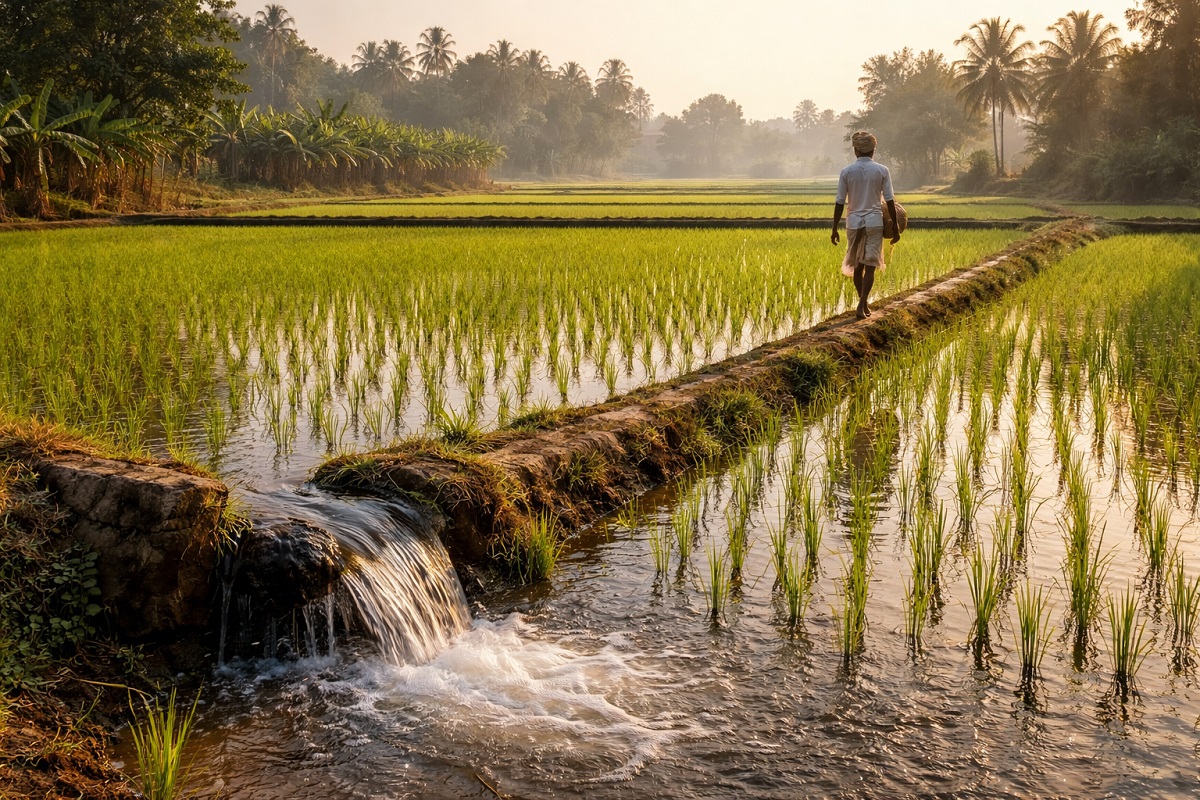
Irrigation for Rice Paddy: Water Management Practices for Higher Yield
Irrigation for rice paddy is fundamentally different from irrigation practices used for most other field crops. Rice is typically grown under flooded conditions, and its water requirement is higher compared to crops such as wheat, pulses, or oilseeds. In India, where rice is a staple food for a large portion of the population, proper irrigation management directly affects productivity, farm income, and food security.
Rice is cultivated across diverse agro-climatic regions, from the irrigated plains of Punjab and Haryana to the delta regions of Tamil Nadu and Andhra Pradesh, and the rainfed lowlands of eastern India. While many farmers depend on monsoon rainfall for transplanting, irrigation for rice paddy becomes essential during dry spells, in rabi and summer seasons, and in areas with uncertain rainfall.
Importance of Irrigation in Rice Cultivation
Rice is a semi-aquatic plant that thrives in standing water conditions. Maintaining proper water depth in the field helps suppress weeds, regulate soil temperature, and create favorable conditions for nutrient availability. However, excess or poorly managed irrigation can lead to nutrient loss, methane emissions, and water wastage.
In irrigated ecosystems, rice yields are significantly higher than in purely rainfed areas. Assured irrigation allows timely transplanting, uniform crop establishment, and stable grain formation. For farmers cultivating high-yielding or hybrid varieties, proper irrigation scheduling is essential to realize the crop’s full potential.
Water Requirement of Rice Paddy
Rice has one of the highest water requirements among cereal crops. On average, rice requires 1200 to 1500 mm of water during its growth cycle. In some traditional flooded systems, total water use may be even higher due to seepage and percolation losses.
The actual water requirement depends on:
- Soil type and percolation rate
- Climate and evaporation levels
- Variety and duration of the crop
- Land leveling and field bunding
Clay soils with good water-holding capacity require less frequent irrigation compared to sandy or loamy soils. Proper puddling and leveling reduce water losses and improve efficiency.
Critical Stages of Irrigation for Rice
Although rice is generally grown under flooded conditions, certain growth stages are particularly sensitive to water stress. Irrigation for rice paddy must ensure adequate moisture during these stages.
Nursery Stage
During nursery raising, the soil must remain moist but not excessively flooded. Proper irrigation at this stage ensures healthy seedling development and strong root growth.
Transplanting Stage
At the time of transplanting, a shallow water layer of 2–3 cm is maintained to help seedlings establish quickly. Excess water at this stage may cause seedlings to float or suffer stress.
Tillering Stage
Tillering is an important stage where the plant produces side shoots. Maintaining 2–5 cm of standing water encourages uniform tiller formation and suppresses weed growth.
Panicle Initiation Stage
Panicle initiation is one of the most critical stages for rice. Water stress at this stage can significantly reduce the number of grains per panicle. Continuous shallow flooding is recommended.
Flowering Stage
Flowering is highly sensitive to moisture stress. Even short periods of water shortage can lead to spikelet sterility and yield reduction. Maintaining consistent water depth is essential.
Grain Filling Stage
During grain filling, adequate moisture ensures proper grain development. However, fields are usually drained 10–15 days before harvest to allow uniform maturity and ease of harvesting.
Traditional Flood Irrigation in Rice
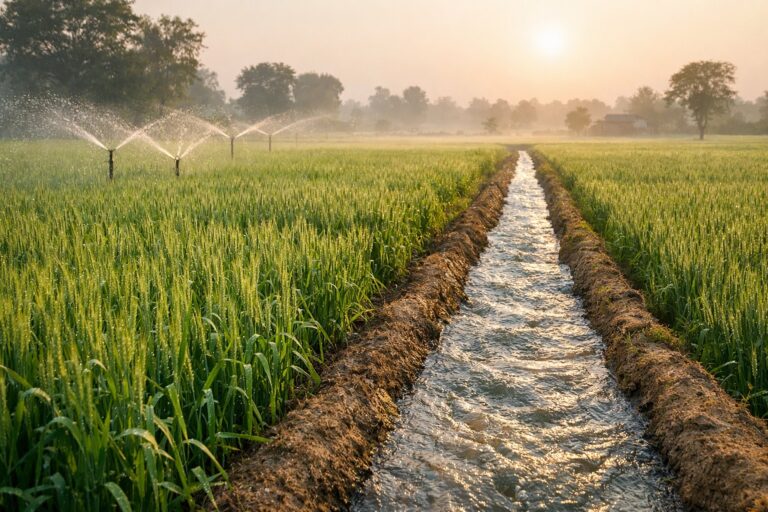
Flood irrigation is the most common method used in rice paddies. In this system, fields are surrounded by bunds and kept submerged under a shallow layer of water.
Advantages of flood irrigation include:
- Effective weed control
- Reduced soil temperature fluctuations
- Improved nutrient availability
However, continuous flooding leads to large water losses through seepage and evaporation. In water-scarce regions, this method is becoming less sustainable.
Alternate Wetting and Drying (AWD) Method
Alternate Wetting and Drying is an improved irrigation technique that allows the field to dry intermittently before re-irrigation. Instead of continuous flooding, irrigation is applied when the water level drops below a certain threshold.
Benefits of AWD include:
- Reduced water use by 20–30%
- Lower methane emissions
- Maintained or improved yields
This method is increasingly promoted in states facing groundwater depletion.
System of Rice Intensification (SRI) and Irrigation
The System of Rice Intensification promotes planting younger seedlings, wider spacing, and controlled irrigation. Under SRI, fields are not continuously flooded. Instead, soil is kept moist with periodic irrigation.
SRI reduces water requirement while improving root growth and tillering. However, it requires careful management and timely operations.
Sources of Irrigation for Rice Paddy
Irrigation for rice paddy in India comes from multiple sources:
- Canal irrigation in northern and delta regions
- Tube wells in Punjab, Haryana, and parts of Uttar Pradesh
- Tanks and reservoirs in southern India
- Rainwater harvesting structures in eastern states
Overdependence on groundwater for paddy cultivation has led to declining water tables in several states, making efficient irrigation practices more important than ever.
Field Preparation and Water Management
Proper land preparation plays a major role in irrigation efficiency. Puddling reduces percolation losses and creates a soft layer for transplanting. Well-constructed bunds prevent water leakage.
Laser land leveling has shown significant improvement in uniform water distribution, reducing water consumption and improving yield.
Common Irrigation Problems in Rice Paddy
- Excess water leading to nutrient leaching
- Water stagnation causing root damage
- Uneven field leveling resulting in patchy growth
- High pumping costs due to deep groundwater levels
Regular monitoring of water depth and timely drainage help prevent these issues.
Water-Saving Strategies for Sustainable Rice Farming
With increasing pressure on water resources, sustainable irrigation for rice paddy is becoming essential. Farmers can adopt the following strategies:
- Adopt Alternate Wetting and Drying
- Use short-duration and drought-tolerant varieties
- Improve field leveling and bund maintenance
- Schedule irrigation based on soil moisture rather than routine flooding
These measures help conserve water without compromising productivity.
Impact of Irrigation on Rice Yield and Quality
Proper irrigation ensures better tiller formation, uniform flowering, and improved grain filling. Consistent water supply during reproductive stages increases grain weight and reduces sterility.
Efficient irrigation also improves fertilizer use efficiency and reduces weed pressure, contributing to higher net returns.
FAQs on Irrigation for Rice Paddy
How much water does rice require?
Rice typically requires 1200–1500 mm of water during its growth cycle, depending on climate and soil conditions.
Is continuous flooding necessary for rice?
No, methods like Alternate Wetting and Drying allow intermittent irrigation without reducing yield.
Which stage is most critical for irrigation in rice?
Panicle initiation and flowering stages are highly sensitive to water stress.
When should irrigation be stopped before harvest?
Irrigation is usually stopped 10–15 days before harvest to allow proper maturity.
Does rice cultivation cause groundwater depletion?
Yes, excessive groundwater use for paddy irrigation has contributed to declining water tables in several states.
What is the ideal water depth in a rice field?
A shallow water layer of 2–5 cm is generally sufficient during most growth stages.
Can rice be grown with less water?
Yes, improved methods like AWD and SRI help reduce water use while maintaining yield.
Conclusion
Irrigation for rice paddy plays a central role in ensuring stable production and food security in India. While traditional flood irrigation has supported rice cultivation for decades, changing water availability demands more efficient practices.
Adopting improved irrigation methods, maintaining proper field preparation, and prioritizing critical growth stages can significantly enhance productivity while conserving water. Sustainable water management in rice farming is not only necessary for higher yields but also for protecting India’s long-term water resources.