Types of Irrigation in India: Methods, Uses, and Practical Insights
Types of irrigation in India have evolved over centuries in response to diverse climates, soil conditions, cropping patterns, and water availability. From traditional flood irrigation practiced since ancient times to modern drip and sprinkler systems, Indian agriculture uses a wide range of irrigation methods. Each type has its own advantages, limitations, and suitability depending on region and crop.
India’s dependence on the monsoon makes irrigation a critical support system for farming. Uneven rainfall, frequent dry spells, and increasing climate uncertainty have made artificial water supply essential for stable crop production. Understanding the different types of irrigation in India helps farmers, planners, and policymakers choose methods that save water, reduce costs, and improve yields.
Overview of Irrigation Practices in India
Irrigation in India can be broadly classified based on the method of water application and the source of water. Traditionally, surface irrigation dominated Indian agriculture, but over time, pressurized and micro-irrigation systems have gained importance, especially in water-scarce regions.
The choice of irrigation method depends on several factors such as land slope, soil texture, crop type, availability of water, and economic capacity of the farmer. No single method is suitable for all situations, which is why multiple types of irrigation coexist across the country.
Surface Irrigation
Surface irrigation is the oldest and most commonly used irrigation method in India. In this system, water flows over the field surface by gravity and infiltrates the soil to reach plant roots. It requires minimal equipment and is easy to operate, making it popular among small and marginal farmers.
Flood Irrigation
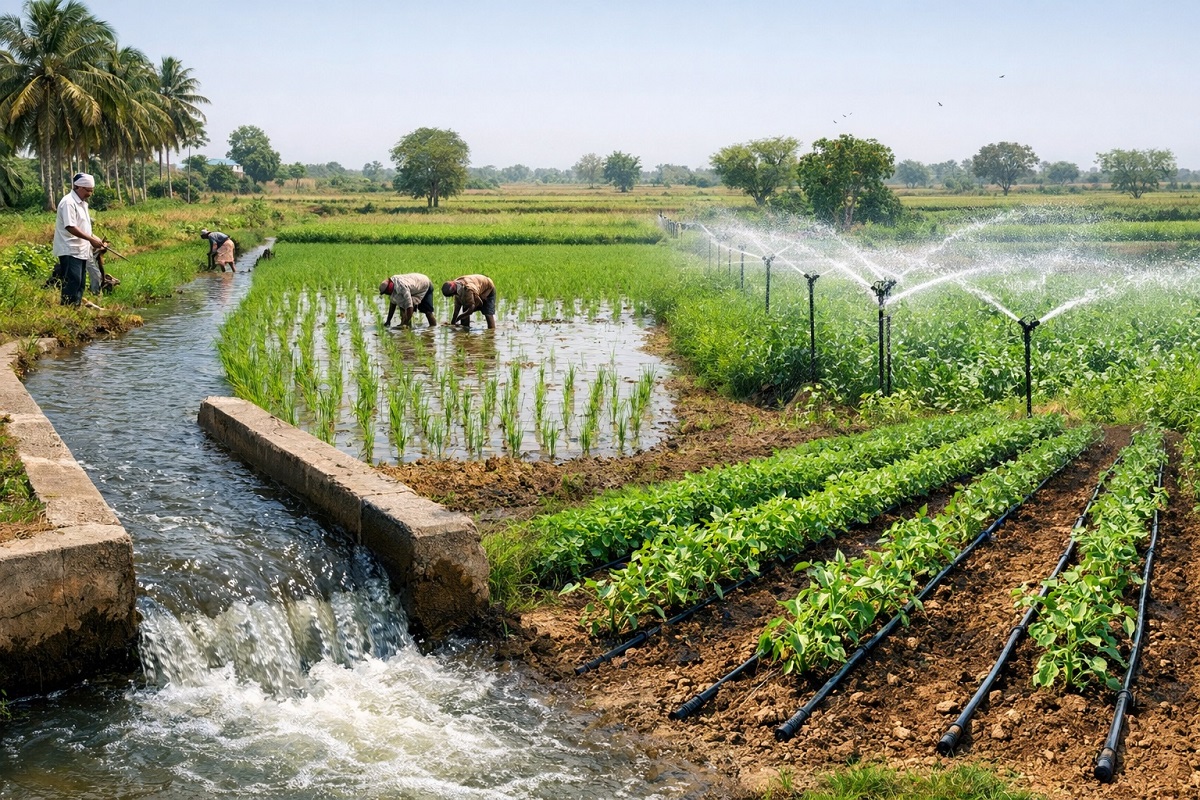
Flood irrigation involves releasing water freely into the field, allowing it to spread and soak the soil. It is widely used for crops like rice and wheat, particularly in canal-irrigated areas.
While flood irrigation is simple and low-cost, it is highly inefficient. Large amounts of water are lost through evaporation, runoff, and deep percolation. Over time, it can also cause waterlogging and soil salinity.
Basin Irrigation
In basin irrigation, fields are divided into small basins surrounded by bunds. Water is applied to each basin separately. This method is commonly used for orchards and tree crops.
Basin irrigation allows better control than flood irrigation but still suffers from water losses if not managed carefully.
Furrow Irrigation
Furrow irrigation uses narrow channels or furrows between crop rows to convey water. Crops such as sugarcane, maize, cotton, and vegetables are often irrigated using this method.
This system reduces water contact with plant stems and improves efficiency compared to flood irrigation. However, uneven land leveling can lead to unequal water distribution.
Subsurface Irrigation
Subsurface irrigation supplies water below the soil surface, either naturally or artificially. In India, this method is less common but exists in areas with high groundwater tables.
Water moves upward through capillary action to reach the root zone. While subsurface irrigation reduces evaporation losses, it is difficult to manage and may lead to salt accumulation near the surface.
Sprinkler Irrigation
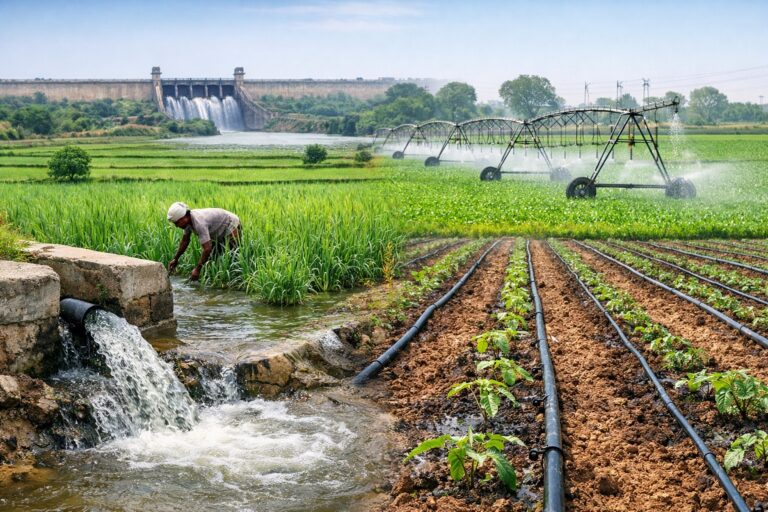
Sprinkler irrigation is a pressurized system that sprays water into the air, allowing it to fall on crops like rainfall. It is suitable for uneven land, sandy soils, and areas with limited water availability.
Sprinkler systems are widely used for crops such as pulses, oilseeds, vegetables, and fodder. They help achieve uniform water application and reduce runoff.
However, high initial investment, energy requirements, and maintenance costs can be limiting factors for small farmers.
Drip Irrigation
Drip irrigation is one of the most efficient types of irrigation in India. It delivers water directly to the root zone through a network of pipes, tubes, and emitters. This minimizes water loss and ensures precise application.
Drip irrigation is especially popular in horticulture, including fruits, vegetables, flowers, and plantation crops like sugarcane and banana.
Although installation costs are high, government subsidies and long-term water savings make drip irrigation economically viable for many farmers.
Micro-Irrigation Systems
Micro-irrigation includes drip and micro-sprinkler systems that apply water in small quantities at frequent intervals. These systems are designed to maximize water-use efficiency.
Micro-irrigation helps improve fertilizer efficiency when combined with fertigation. It also reduces weed growth and soil erosion.
Canal Irrigation
Canal irrigation is based on diverting water from rivers through canals and distributaries. It is common in northern and southern plains where large river systems exist.
This method supports irrigation over large areas but often faces challenges such as seepage losses, poor maintenance, and unequal distribution.
Well and Tube Well Irrigation
Well irrigation uses groundwater drawn from open wells, while tube wells use pumps to extract water from deeper aquifers. This is the most dominant irrigation source in India today.
Groundwater irrigation gives farmers flexibility but has led to serious issues such as falling water tables and increased pumping costs.
Tank Irrigation
Tank irrigation involves storing rainwater in small reservoirs or tanks and using it for irrigation during dry periods. It is common in southern and eastern India.
Tanks also help recharge groundwater and support local ecosystems, but many have lost capacity due to siltation and neglect.
Lift Irrigation
Lift irrigation involves pumping water from rivers or reservoirs to higher elevations. It is used in areas where gravity flow is not possible.
While effective, lift irrigation depends heavily on electricity or diesel, increasing operational costs.
Factors Influencing Choice of Irrigation Method
- Availability and reliability of water source
- Type of crop and its water requirement
- Soil texture and infiltration rate
- Land topography and slope
- Economic condition of the farmer
Advantages and Limitations of Different Types of Irrigation
No irrigation method is perfect. Surface methods are affordable but inefficient. Pressurized systems save water but require higher investment. Sustainable irrigation requires matching the right method to local conditions.
Role of Modern Irrigation in Sustainable Farming
With increasing water scarcity, efficient irrigation methods such as drip and sprinkler systems are becoming essential. These systems help conserve water, reduce input costs, and improve crop productivity.
Combining irrigation with rainwater harvesting and soil moisture conservation practices strengthens farm resilience.
FAQs on Types of Irrigation in India
What are the main types of irrigation in India?
The main types include surface irrigation, sprinkler irrigation, drip irrigation, canal irrigation, well irrigation, and tank irrigation.
Which irrigation method uses the least water?
Drip irrigation uses the least water as it delivers water directly to plant roots.
Why is surface irrigation still widely used?
Surface irrigation is simple, low-cost, and suitable for traditional cropping systems.
Is sprinkler irrigation suitable for all crops?
No, it is less suitable for crops sensitive to leaf wetting or strong winds.
What type of irrigation is best for water-scarce areas?
Drip and sprinkler irrigation are best for water-scarce regions.
Does groundwater irrigation have long-term risks?
Yes, overuse of groundwater can lead to depletion and increased pumping costs.
How can farmers choose the right irrigation method?
Farmers should consider water availability, crop needs, soil type, and cost before selecting an irrigation method.
Conclusion
Types of irrigation in India reflect the country’s agricultural diversity and water challenges. From traditional surface methods to advanced micro-irrigation systems, each plays a role in supporting crop production. As water resources become increasingly stressed, the focus must shift toward efficient, sustainable irrigation practices.
Choosing the right irrigation method is not just a technical decision but a critical step toward long-term farm sustainability. By adopting suitable irrigation systems and managing water wisely, Indian agriculture can continue to feed the nation while conserving its precious water resources.