Irrigation in India: Systems, Challenges and Future
Irrigation in India has always been closely tied to the country’s food security, rural livelihoods, and economic stability. From ancient stepwells and tank systems to modern drip irrigation and large river valley projects, Indian farmers have relied on artificial water supply to cope with uncertain rainfall. Even today, despite advances in technology, irrigation remains one of the most critical and challenging aspects of Indian agriculture.
India receives a large amount of rainfall annually, but its distribution is uneven across regions and seasons. The southwest monsoon, which supplies nearly 75% of the country’s annual rainfall, is concentrated within a few months. This makes irrigation essential for sustaining crops during dry spells, supporting multiple cropping seasons, and reducing farmers’ dependence on erratic weather.
Importance of Irrigation in Indian Agriculture
Agriculture in India employs a significant portion of the population and contributes to national food supplies. However, only a part of the cultivated land receives assured irrigation. Irrigation helps stabilize crop production by ensuring timely water availability, especially for water-intensive crops such as rice, sugarcane, and wheat.
In rainfed areas, crop yields are highly vulnerable to monsoon failure or delayed rains. Proper irrigation reduces this risk and allows farmers to plan sowing and harvesting with greater confidence. It also enables diversification into cash crops, vegetables, and fruits, which require controlled water supply at specific growth stages.
Irrigation also plays a vital role in increasing cropping intensity. With reliable water, farmers can grow two or even three crops in a year instead of leaving land fallow after the monsoon season. This directly improves farm income and rural employment.
Major Sources of Irrigation in India
Irrigation in India depends on a mix of surface water and groundwater sources. The choice of source varies by region, climate, soil type, and availability of infrastructure.
Canals
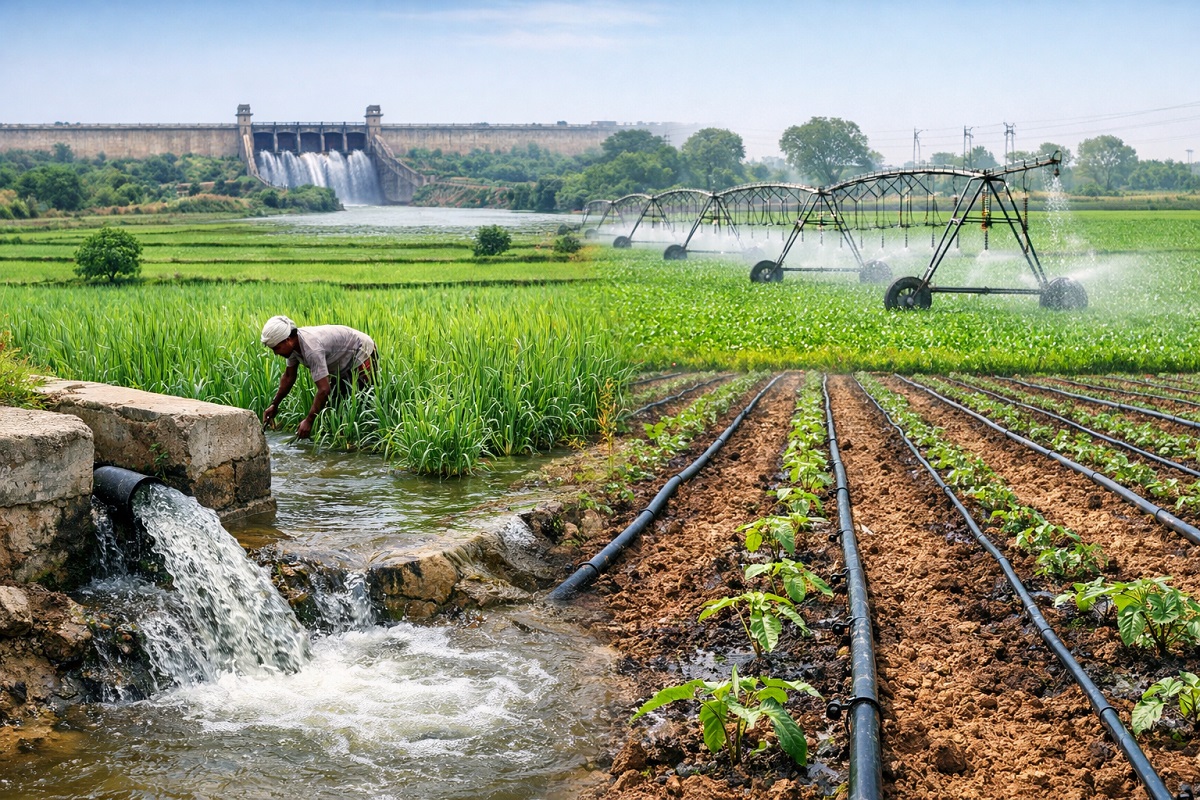
Canal irrigation is one of the oldest and most widespread methods in India. It involves diverting water from rivers through a network of canals to agricultural fields. Major canal systems are found in states like Punjab, Haryana, Uttar Pradesh, and Andhra Pradesh.
Canals are particularly useful for irrigating large command areas. However, they often suffer from issues such as water losses due to seepage, uneven distribution, and maintenance challenges. Tail-end farmers frequently receive less water than those near the head of the canal.
Wells and Tube Wells
Groundwater irrigation through open wells and tube wells has expanded rapidly over the past few decades. Today, groundwater accounts for a major share of irrigated area in India. Farmers prefer wells because they offer greater control over water timing and quantity.
States like Punjab, Haryana, Rajasthan, and parts of Tamil Nadu heavily depend on tube wells. While this has boosted agricultural output, excessive groundwater extraction has led to declining water tables in many regions.
Tanks and Reservoirs
Tanks are traditional water storage systems commonly found in southern and eastern India. They collect rainwater and runoff during the monsoon and supply water during dry periods. Tanks also support groundwater recharge and local ecosystems.
Large reservoirs built as part of multipurpose river projects serve irrigation, drinking water, and power generation needs. However, sedimentation and poor upkeep have reduced the storage capacity of many tanks over time.
Types of Irrigation Methods Used in India
Indian farmers use a range of irrigation methods depending on crop type, soil condition, and water availability.
Surface Irrigation
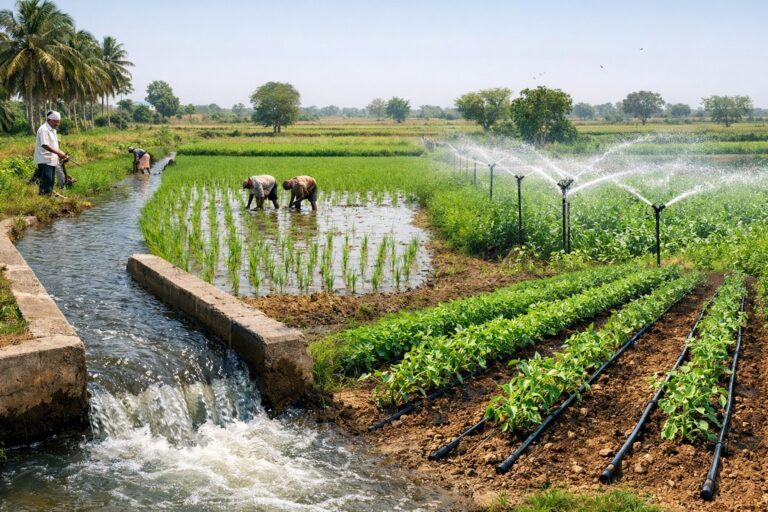
Surface irrigation involves flooding or channeling water across the field surface. Common techniques include flood irrigation, basin irrigation, and furrow irrigation. These methods are simple and low-cost but often result in high water losses through evaporation and runoff.
Sprinkler Irrigation
Sprinkler irrigation applies water in the form of spray, similar to rainfall. It is suitable for uneven land and light soils. Sprinklers help reduce water wastage and improve uniformity of application, making them useful in semi-arid regions.
Drip Irrigation
Drip irrigation delivers water directly to the plant root zone through pipes and emitters. It is one of the most water-efficient methods available today. Drip systems are widely used in horticultural crops such as fruits, vegetables, and plantation crops.
Although initial installation costs are high, government subsidies and long-term water savings make drip irrigation an attractive option for many farmers.
Regional Patterns of Irrigation in India
Irrigation development in India shows strong regional variation. Northern plains benefit from extensive canal networks and abundant groundwater. Southern states rely more on tanks, reservoirs, and micro-irrigation systems.
Eastern India, despite receiving high rainfall, has relatively low irrigation coverage due to poor infrastructure and flood-prone conditions. Western India faces acute water scarcity and depends heavily on groundwater and efficient irrigation methods.
These regional differences highlight the need for location-specific irrigation planning rather than a uniform national approach.
Challenges Facing Irrigation in India
Despite significant investments, irrigation in India faces several structural and environmental challenges.
- Over-extraction of groundwater leading to falling water tables
- Uneven distribution of canal water
- Poor maintenance of irrigation infrastructure
- Waterlogging and soil salinity in canal-irrigated areas
- Climate change increasing rainfall variability
Small and marginal farmers often lack access to reliable irrigation, making them more vulnerable to crop failure. Rising energy costs for pumping groundwater further add to their burden.
Government Initiatives for Improving Irrigation
The Indian government has launched several schemes to improve irrigation efficiency and coverage. The Pradhan Mantri Krishi Sinchayee Yojana focuses on expanding irrigated area and promoting water-use efficiency through micro-irrigation.
Other initiatives encourage watershed development, renovation of tanks, and adoption of modern irrigation technologies. Subsidies for drip and sprinkler systems have helped increase their adoption, especially in water-scarce regions.
Role of Irrigation in Climate-Resilient Farming
Climate change has increased the frequency of droughts, floods, and unpredictable rainfall patterns. Efficient irrigation systems can help farmers adapt to these changes by ensuring timely water supply during critical crop stages.
Practices such as rainwater harvesting, conjunctive use of surface and groundwater, and precision irrigation contribute to long-term water security and sustainable farming.
Future of Irrigation in India
The future of irrigation in India depends on balancing water demand with available resources. Improving water-use efficiency, strengthening local water governance, and promoting farmer awareness are essential steps.
Technology will play a key role, but traditional knowledge and community-based water management systems should not be overlooked. A combination of modern science and local practices offers the best path forward.
FAQs on Irrigation in India
What is the main source of irrigation in India?
Groundwater through wells and tube wells is currently the main source of irrigation in India.
Why is irrigation important for Indian farmers?
Irrigation ensures stable crop production, reduces dependence on rainfall, and allows multiple cropping seasons.
Which states have the highest irrigation coverage?
Punjab, Haryana, and Uttar Pradesh have some of the highest irrigation coverage due to canals and groundwater use.
What are the disadvantages of canal irrigation?
Canal irrigation can lead to waterlogging, salinity, and uneven water distribution if not properly managed.
How does drip irrigation help save water?
Drip irrigation delivers water directly to plant roots, reducing evaporation and runoff losses.
Is irrigation linked to groundwater depletion?
Yes, excessive and unregulated groundwater extraction for irrigation has caused declining water tables in many regions.
What role does irrigation play in food security?
Irrigation stabilizes crop yields and supports the production of staple and cash crops, contributing to national food security.
Conclusion
Irrigation in India remains a cornerstone of agricultural productivity and rural livelihoods. While the country has made progress in expanding irrigated areas, significant challenges persist in terms of efficiency, equity, and sustainability. Addressing these issues requires coordinated efforts from farmers, policymakers, and local communities.
By adopting water-saving technologies, improving infrastructure maintenance, and respecting regional water realities, India can strengthen its irrigation systems for future generations. A thoughtful approach to irrigation will not only support farmers but also safeguard the nation’s precious water resources.